

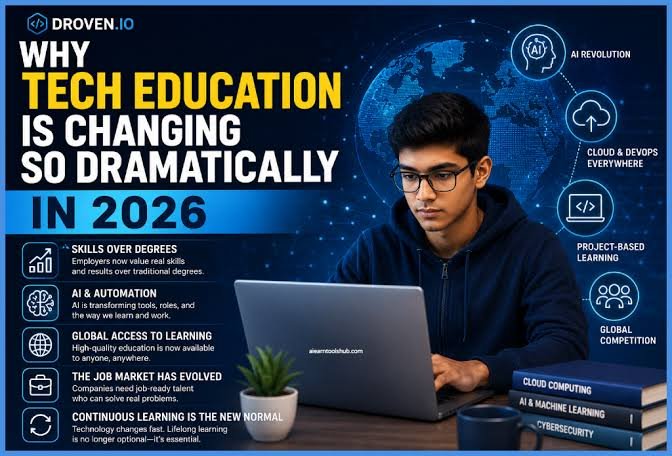
Technology is changing how people learn valuable skills.
AI now makes knowledge faster, cheaper, and easier to access.
But faster access does not always create better learning. The bigger change involves how students practice, verify, and prove skills.
Droven.io tech education trends fit within this wider shift. The platform covers AI, software development, cybersecurity, digital transformation, data, and future technology. It also publishes content connected with online learning and professional training.
Droven.io in One Minute
Before discussing education trends, one distinction matters.
Droven.io is primarily a technology editorial platform. Its official site focuses heavily on AI and digital innovation. It is not presented as a traditional university.
| Quick Fact | Details |
|---|---|
| Platform | Droven.io |
| Primary Area | Technology publishing |
| Major Focus | AI and digital transformation |
| Other Topics | Cybersecurity, software, data, future tech |
| Education Connection | Technology and learning-related information |
| Main Format | Articles, guides, reviews, insights |
| Formal University | Not established |
| Degree Provider | Not established |
| Key Value | Explaining changing technologies |
Droven.io currently describes itself as an editorial source. Its coverage includes generative AI and future work. It also covers software development and information technology.
That distinction prevents a common mistake.
Educational content does not automatically make a website an educational institution.
The 2026 Tech Learning Map
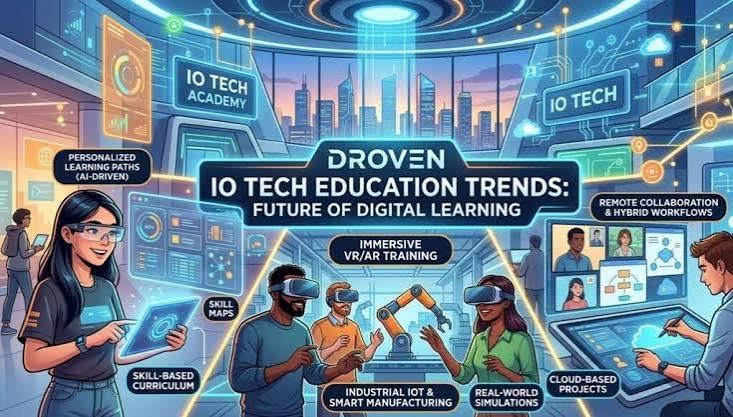
Digital education is moving in several directions simultaneously.
AI receives the most attention. However, it is only one part.
| Learning Trend | Main Benefit | Practical Use | Main Concern |
|---|---|---|---|
| Generative AI | Faster assistance | Research and explanations | Incorrect answers |
| Adaptive Learning | Personalization | Individual practice | Algorithm dependence |
| Microlearning | Faster study | Short skill lessons | Limited depth |
| VR/AR | Visual experience | Simulations | Cost and access |
| Data Analytics | Better insights | Progress tracking | Privacy |
| Cloud Learning | Easy access | Remote study | Internet dependence |
| Gamification | More engagement | Practice activities | Distraction |
| Automation | Saves time | Routine learning tasks | Over-reliance |
The pattern behind these trends matters.
Technology increasingly handles delivery and repetition.
Humans remain responsible for understanding and judgment.
That difference could shape successful education systems.
From Classroom Learning to Skill Learning
Education traditionally followed a predictable route.
Students attended classes. Teachers delivered lessons. Exams measured memory.
Digital technology weakens those boundaries.
Someone learning web development can now combine documentation, videos, AI assistance, coding environments, and real projects.
Learning becomes less linear.
Traditional Model
Study → Memorize → Exam → Qualification
Emerging Model
Learn → Practice → Build → Test → Improve → Demonstrate
The second model produces something important: evidence.
A student saying, “I understand Python,” provides little proof.
A working Python project provides more evidence.
Explaining that project provides even stronger evidence.
Fixing its errors shows deeper understanding.
This changes what education can measure.
Degree vs Skill Is the Wrong Debate
Degrees still have value.
They provide structured foundations and deeper academic study.
Short courses solve another problem. They allow professionals to update skills quickly.
The stronger future model may combine both:
Deep education + continuous skill updates.
Students may stop viewing education as something completed once.
Learning could become a career-long process.
The Trend Most Education Articles Miss
Generative AI creates an unusual education problem.
Producing good work no longer proves someone understands it.
Consider a student who submits excellent computer code.
AI may have generated most of it.
The code could work perfectly. Yet the student might not understand why.
The same issue affects essays, presentations, reports, designs, and research summaries.
This creates a new requirement: proof of understanding.
The Five-Step Skill Test
| Test | Question |
|---|---|
| Create | Can you produce useful work? |
| Explain | Can you explain how it works? |
| Verify | Can you detect mistakes? |
| Modify | Can you adapt the work? |
| Defend | Can you justify your choices? |
This framework goes beyond traditional assessment.
Imagine AI creates a website for a student.
Instead of simply grading the website, an educator could change one requirement.
Then the student must modify the code.
Next, the teacher could introduce an error.
The student must identify it.
Finally, the student explains the solution.
AI can help create the original output.
Understanding becomes much harder to fake.
That may become one of digital education’s most important changes.
What Students Actually Need Now
Learning every trending application is impossible.
Tools can become popular and disappear quickly.
Students therefore need durable abilities beneath those tools.
The Modern Skill Stack
Foundation — Core Knowledge
Students still need subject fundamentals.
AI assistance becomes more useful when foundations are strong.
Layer Two — AI Literacy
Students should understand AI capabilities.
They should also understand its limitations.
Using AI and understanding AI are different skills.
Layer Three — Verification
Generated information needs checking.
A confident AI response can still contain errors.
Students need reliable verification habits.
Layer Four — Data Literacy
Modern technology produces enormous amounts of data.
People need to understand patterns, sources, and limitations.
Layer Five — Communication
Technical knowledge alone has limited value.
People must explain ideas clearly to others.
Top Layer — Human Judgment
This may become the hardest skill to automate.
Technology can produce multiple answers.
Humans must decide which answer makes sense.
Why This Stack Matters
Consider two students using identical AI tools.
Student A copies generated answers.
Student B questions them.
Student B tests claims and identifies weaknesses. They then improve the final result.
Both students have AI access.
Only one develops stronger judgment.
That difference matters more as AI becomes widely available.
Where Technology Helps — and Where It Still Fails
Education technology works best when its purpose is clear.
Adding technology simply because it looks modern creates little value.
| Technology Does Well | Humans Remain Important For |
|---|---|
| Fast explanations | Understanding personal context |
| Repetitive practice | Emotional encouragement |
| Content generation | Original judgment |
| Large-scale analysis | Ethical decisions |
| Instant feedback | Complex mentoring |
| Information retrieval | Evaluating significance |
| Routine automation | Handling unusual situations |
AI can explain one concept repeatedly without becoming tired.
That can help struggling learners.
However, an educator may notice something AI misses.
The student might understand the lesson but lack confidence.
Another student might memorize answers without understanding.
Human observation still matters.
Personalization Also Has Limits
Personalized learning sounds completely positive.
Yet excessive personalization creates risks.
Students sometimes need difficult material.
Struggle can be part of learning.
An adaptive system should not continually make work easier.
Effective personalization should change the route, not lower the standard.
That distinction deserves more attention.
A Reality Check on Droven.io
Droven.io covers technology subjects that can support digital learning.
Its official site currently features artificial intelligence, generative AI, AI tools, cybersecurity, software development, digital transformation, big data, and future-of-work topics.
It also publishes some learning-related material.
However, readers should distinguish editorial coverage from direct services.
| Statement | Status |
|---|---|
| Droven.io publishes technology content | Confirmed |
| AI is a major coverage area | Confirmed |
| It covers software development | Confirmed |
| It covers cybersecurity and privacy | Confirmed |
| It publishes digital transformation content | Confirmed |
| It has learning-related articles | Confirmed |
| It is a university | Not established |
| It awards academic degrees | Not established |
| It operates physical classrooms | Not established |
| It provides its own AI tutor | Not established |
This matters for factual accuracy.
An article should not transform a topic discussed by a website into a service provided by that website.
For example, discussing virtual reality education does not prove a platform operates VR classrooms.
That verification habit improves reader trust.
What Tech Education Could Look Like by 2030
Nobody can verify exactly what education will look like in 2030.
Still, current developments reveal several plausible directions.
AI assistance could become normal rather than exceptional.
Students may use AI alongside search engines and traditional resources.
Assessment could change more dramatically.
Schools may rely less on easily generated homework. Live demonstrations, projects, discussions, and practical assessments could become more useful.
Digital portfolios could also gain importance.
Instead of only showing certificates, candidates could demonstrate completed work.
A Possible Learning Journey
Learn the concept
↓
Use AI for assistance
↓
Build something practical
↓
Test the result
↓
Verify important information
↓
Explain your decisions
↓
Store the project as evidence
This model measures more than memory.
It measures applied understanding.
Teachers Are Unlikely to Become Irrelevant
AI can reduce repetitive educational work.
That does not eliminate teaching.
It may shift teacher value toward higher-level activities.
Teachers can focus more on:
- Critical thinking
- Complex feedback
- Project evaluation
- Discussion
- Misconceptions
- Ethics
- Motivation
The teacher becomes less like an information distributor.
The role becomes closer to a learning guide.
The 30-Second Takeaway
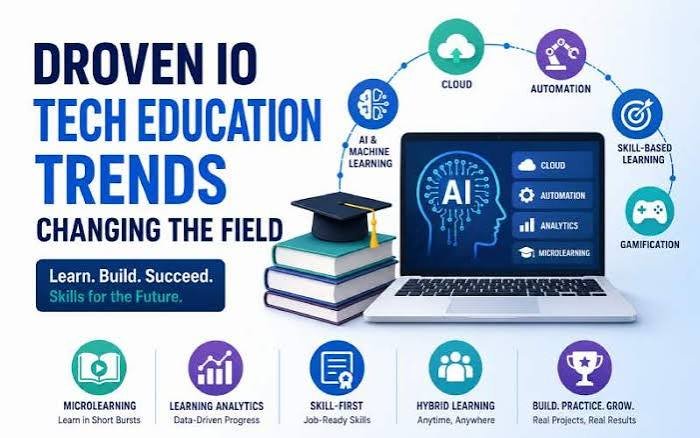
Droven.io tech education trends belong to a larger transformation in learning.
AI is making information easier to obtain. Digital platforms make skills easier to practice. Flexible learning allows people to study throughout their careers.
But easy information creates a new challenge.
Students must prove they understand what technology produces.
The strongest future learner will not simply know AI tools.
They will know how to create, explain, verify, modify, and defend their work.
That is the difference between using technology and actually learning from it.
Read more :FLPMarkable Free Logos by FreeLogoPNG: What You Should Know
